The dental implant procedure step by step includes consultation, digital imaging, implant placement, healing, abutment attachment, and final crown fitting. The complete dental implant process may take several months because the implant needs time to integrate with the jawbone. However, the exact treatment timeline differs for every patient.
At KissDent in Tirana, each stage is personalized using digital diagnostics, careful implant planning, and an in-house dental laboratory.
What Is a Dental Implant?
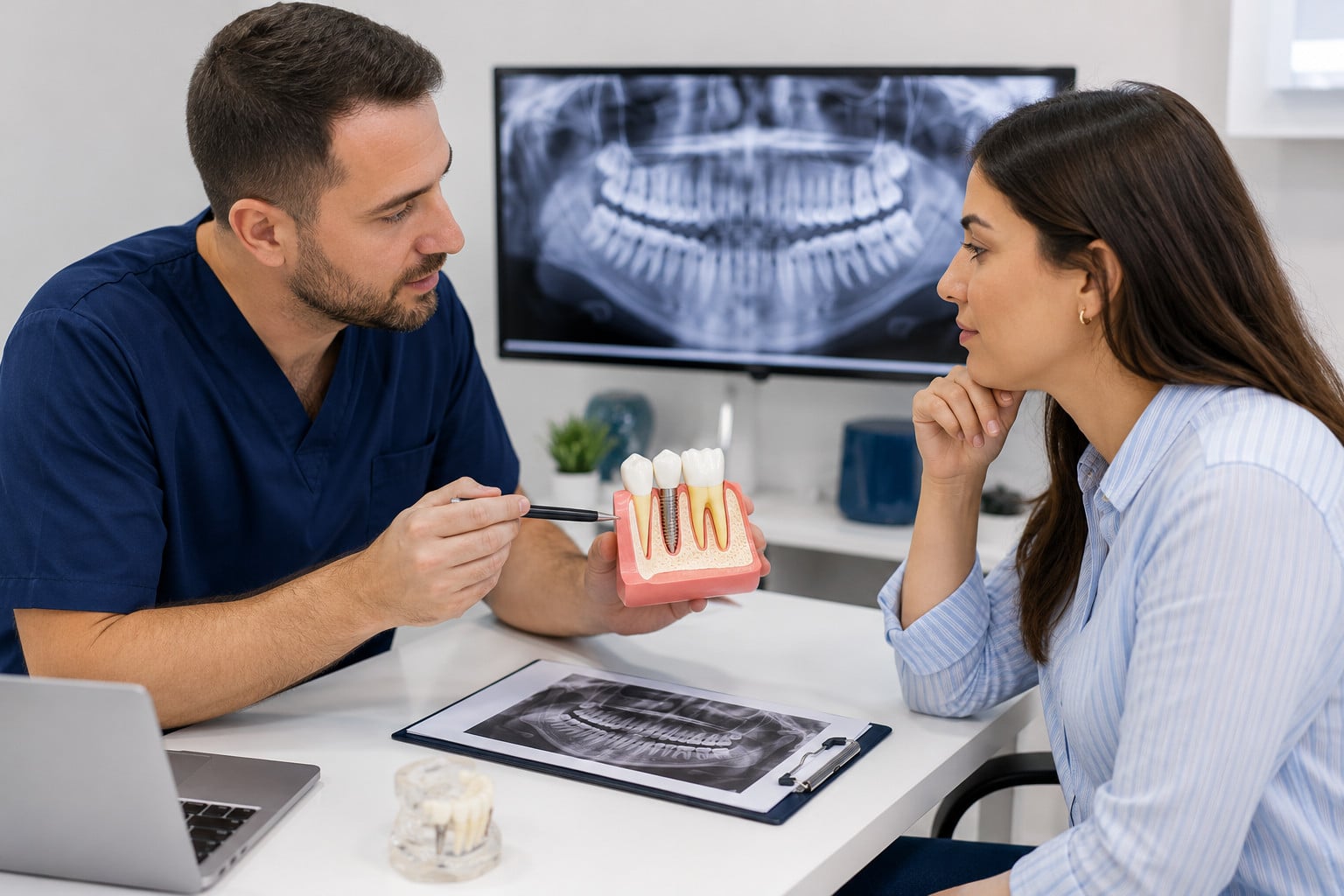
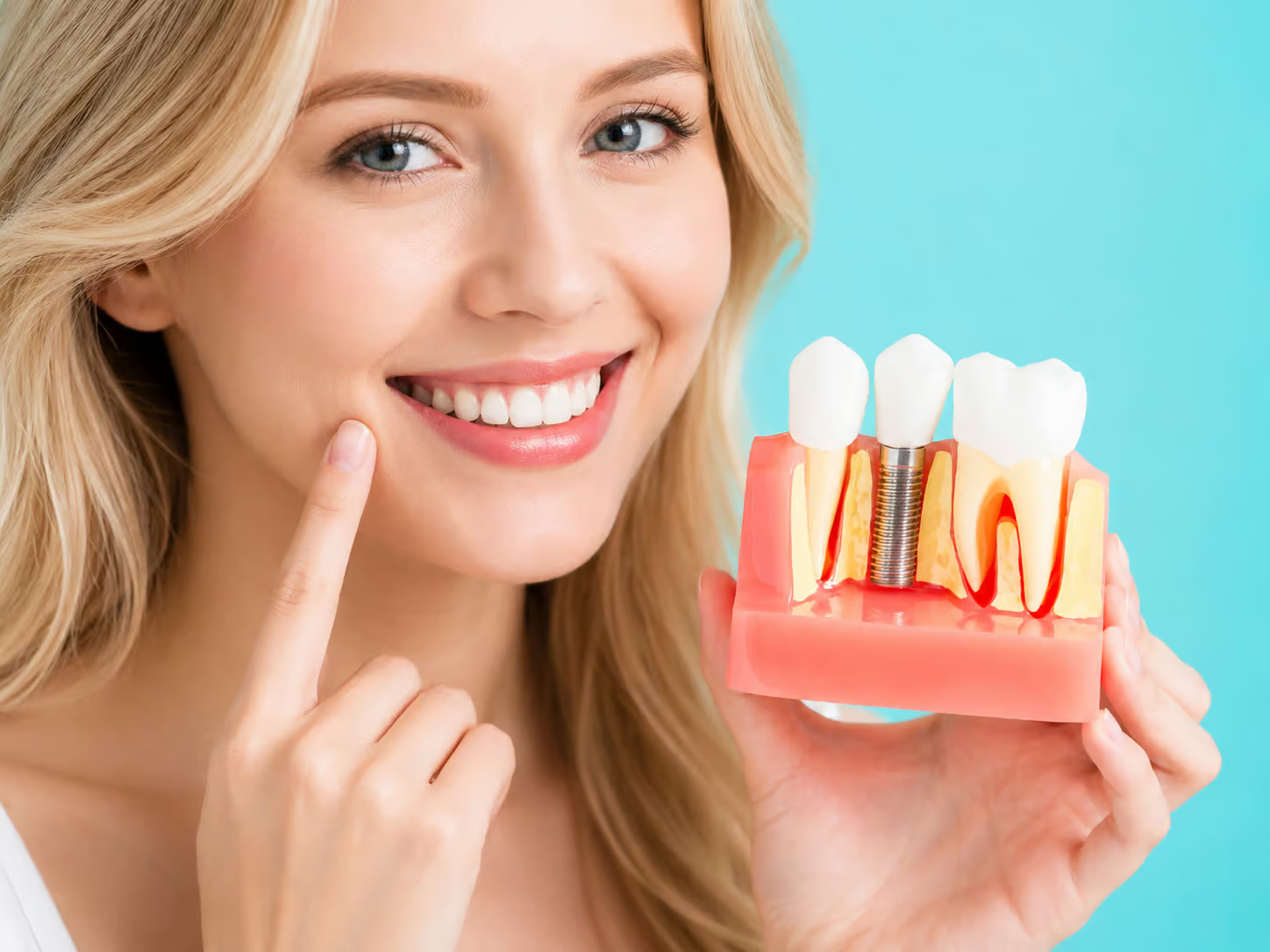
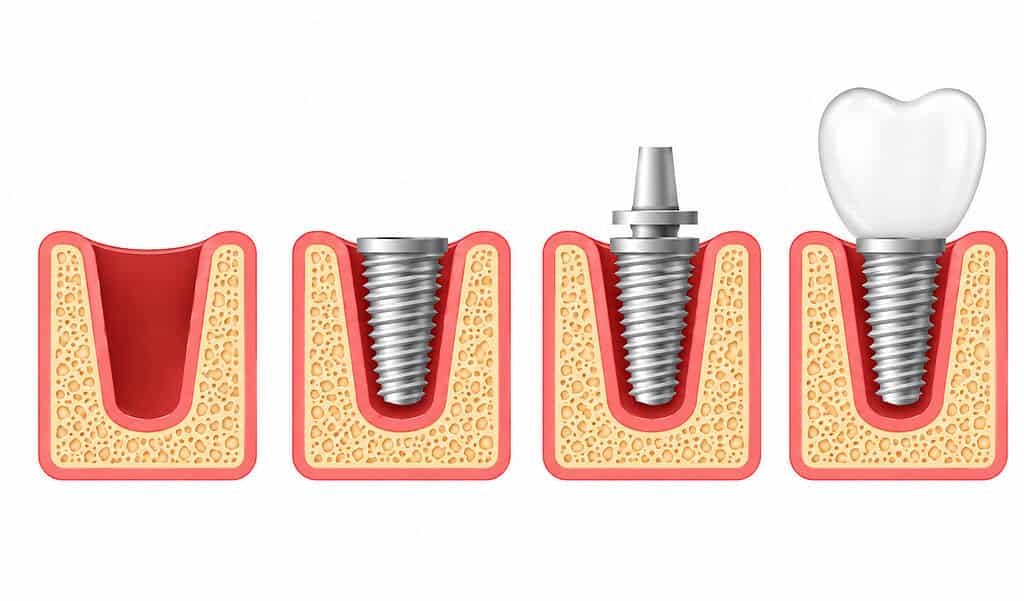
A dental implant is a small titanium post placed in the jawbone to replace a missing tooth root. Once stable, it can support a crown, bridge, or complete fixed dental restoration.
A complete implant restoration normally has three main parts:
- The implant positioned in the jawbone
- The abutment connecting the implant and restoration
- The crown or bridge visible above the gum
Unlike a conventional bridge, a single implant can replace a missing tooth without requiring the neighboring healthy teeth to support the restoration.
Dental Implant Procedure Step-by-Step Overview
| Dental implant stage | What happens |
| Consultation | The dentist examines your mouth and discusses your dental and medical history |
| Digital diagnostics | X-rays or three-dimensional images are used to examine the bone and surrounding structures |
| Preparation | Existing dental problems are treated before implant placement |
| Implant placement | The titanium implant is positioned in the jawbone |
| Healing | The implant integrates with the surrounding bone |
| Abutment | A connector is attached to the implant |
| Digital impression | The crown or bridge is designed according to your mouth and bite |
| Final restoration | The customized crown or fixed bridge is attached |
| Maintenance | Regular cleaning and examinations help protect the implant |
Step 1: Dental Implant Consultation
The dental implant process begins with a detailed consultation. The dentist examines the missing tooth, gums, remaining teeth, and bite.
Your dental and general health history will also be reviewed. Certain conditions and medications can affect healing, so it is important to provide complete and accurate information.
International patients can begin with an online consultation. KissDent may request:
- A recent panoramic dental X-ray
- Clear photographs of the teeth
- Information about missing or damaged teeth
- Details about previous dental procedures
- Relevant medical information
This initial evaluation helps the clinic understand your needs before you travel. The final treatment plan is confirmed after an in-clinic examination in Tirana.
Patients planning treatment abroad can learn more about dental tourism in Albania.
Step 2: Digital X-Rays and Implant Planning
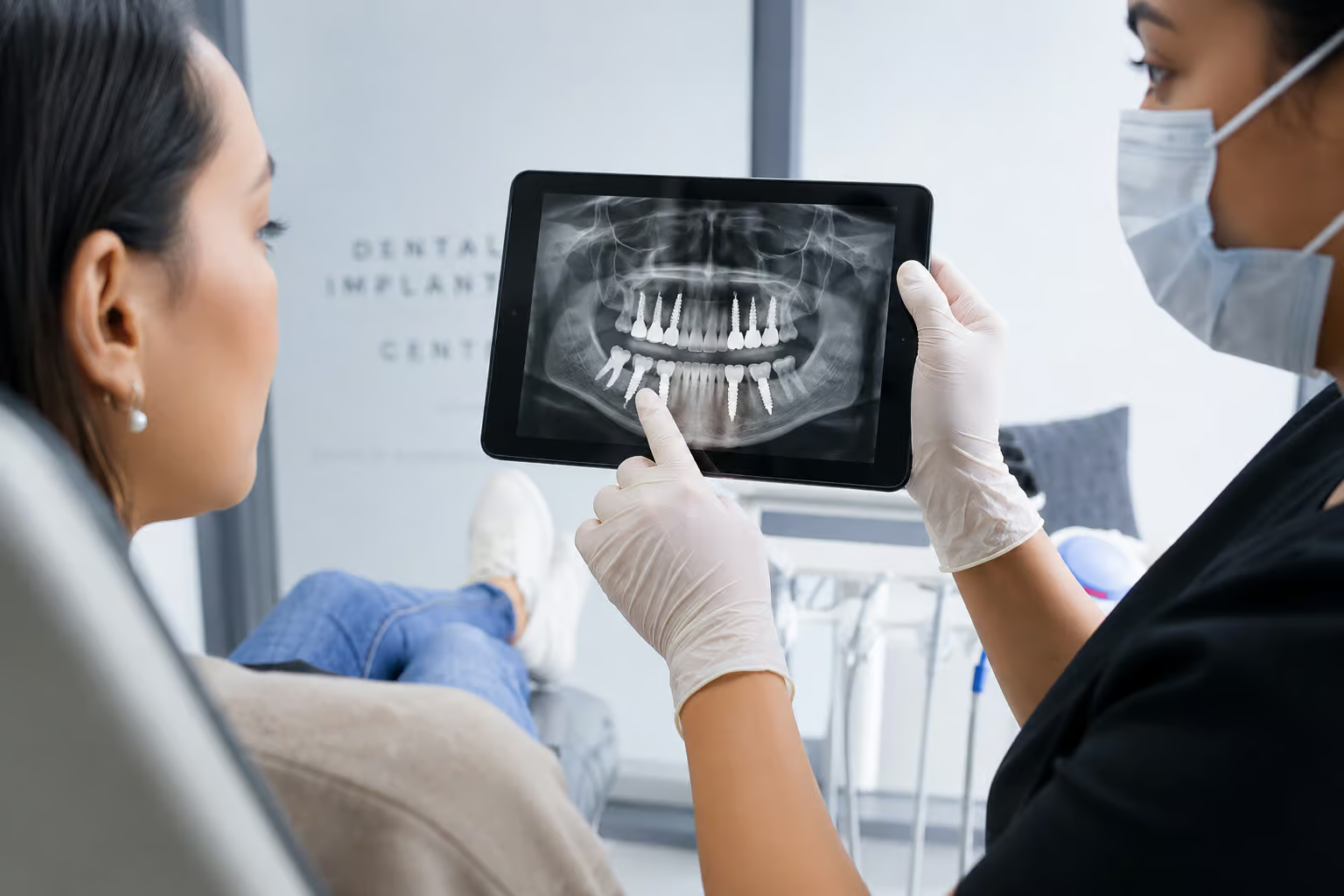
Digital imaging is essential for planning the dental implant procedure. It helps the dentist evaluate the available bone and identify important structures around the planned implant site.
The assessment may examine:
- Jawbone height and width
- Bone quality around the missing tooth
- Position of neighboring tooth roots
- Condition of the gums
- Bite and chewing forces
- Number and position of the required implants
- Type of final restoration
The dentist uses this information to create a personalized treatment plan. It should explain the recommended procedure, expected timeline, number of appointments, and final prosthetic option.
KissDent uses digital dental X-rays to support accurate diagnosis and treatment planning.
Step 3: Preparing the Mouth for Dental Implants
Some patients can proceed directly to implant placement. Others require preparatory care to create a healthier and more stable foundation.
Preparation may include:
- Professional dental cleaning
- Treatment of gum inflammation
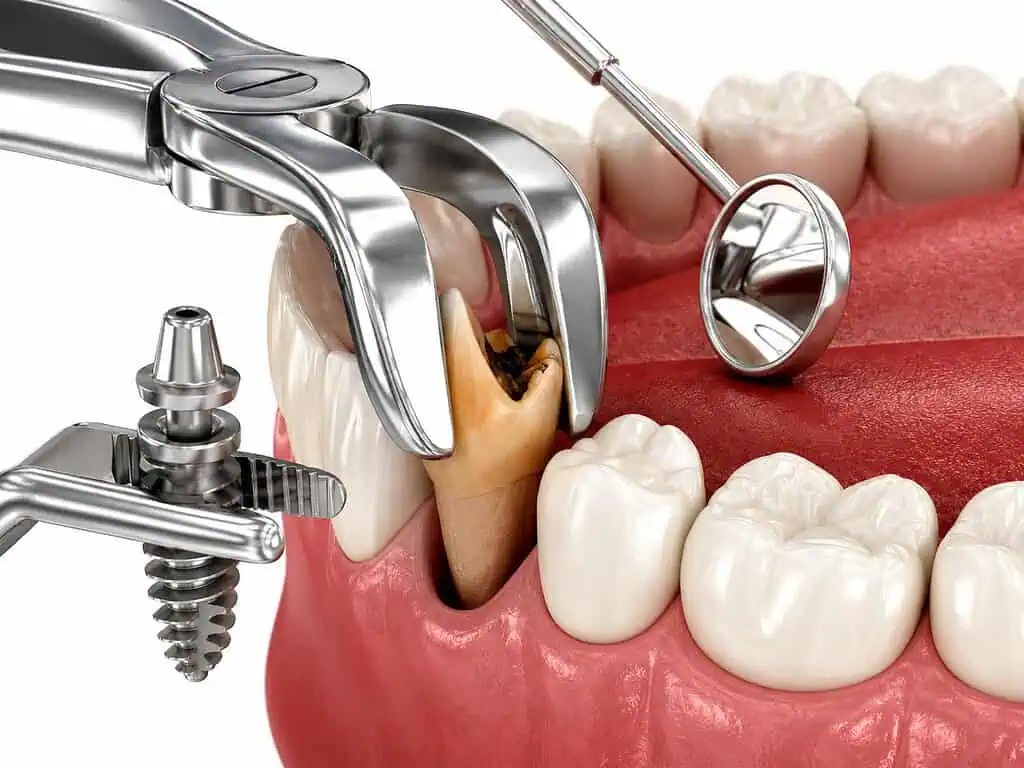
- Removal of an unsalvageable tooth
- Treatment of an existing infection
- Bone regeneration
- A sinus lift
A damaged tooth may sometimes be removed and replaced with an implant during the same appointment. However, this is not possible in every case.
The dentist must examine the extraction site, bone volume, soft tissues, and implant stability before recommending immediate placement.
Step 4: Bone Regeneration or Sinus Lift When Required
The jawbone must provide sufficient support for a dental implant. After a tooth has been missing for an extended period, the bone in that area may reduce in volume.
Bone regeneration may be recommended when the implant site does not have enough bone. The added material supports the formation of a more suitable implant foundation.
A sinus lift may be necessary when implants are planned in the upper back jaw and the available bone beneath the sinus is limited.
These procedures can sometimes be performed together with implant placement. In other cases, the area must heal first.
Read more about bone grafting and sinus lift treatment at KissDent.
Step 5: Dental Implant Placement
Implant placement is performed after the treatment area has been prepared. Local anesthesia is used to numb the area and maintain comfort during the procedure.
The dentist prepares a precise space within the jawbone. The titanium implant is then positioned according to the digital treatment plan.
A healing component may be attached, or the implant may be covered during the healing stage. The selected method depends on the implant system and the individual case.
The appointment may be longer when several implants, extractions, or additional procedures are required. Patients receive clear aftercare instructions before leaving the clinic.
Step 6: Healing and Osseointegration
The next part of the dental implant procedure is the healing stage. During this period, the surrounding bone gradually bonds with the implant surface.
This process is known as osseointegration. Successful integration creates the stable foundation needed to support the final crown or bridge.
Healing often takes several months, but the exact duration varies. It may be influenced by:
- Implant position
- Bone quality and volume
- Number of implants
- Additional bone procedures
- General health
- Oral hygiene
- Following postoperative instructions
A temporary restoration may be provided when clinically appropriate. Its use depends on implant stability, the location being treated, and the pressure the restoration may receive.
Step 7: Follow-Up Examination
Follow-up appointments allow the dentist to monitor the healing process. The gums, implant site, and surrounding tissues are examined.
Additional imaging may be used when necessary. The final restoration should only proceed when the implant has reached the required stability.
Patients should contact the clinic if they notice unexpected or worsening symptoms. They should not wait until the next appointment if they are concerned about healing.
Step 8: Attaching the Abutment
Once osseointegration is complete, the implant is prepared for the final restoration. A small connector called an abutment is attached to the implant.
The abutment extends above the gum and supports the crown or bridge. Depending on the clinical technique, it may be connected during implant placement or after healing.
The gum may need a short period to form around the abutment. This creates a suitable shape for the final restoration.
Step 9: Taking a Digital Impression
The dental team records the position of the implant, surrounding teeth, gums, and bite. Digital impressions can collect this information without relying entirely on traditional impression material.
These records help determine the correct:
- Crown shape and size
- Tooth shade
- Gum profile
- Position within the smile
- Contact with neighboring teeth
- Bite relationship
KissDent’s in-house dental laboratory allows dentists and dental technicians to coordinate the restoration under the same roof. This supports efficient communication when adjusting the shape, shade, and bite.
Step 10: Creating and Fitting the Final Crown
The crown is the visible part of a single-tooth implant. It is customized to match the proportions and appearance of the surrounding teeth.
The dentist checks the restoration before it is secured. The fit, shape, shade, gum contact, and bite are carefully evaluated.
Small adjustments may be made to improve comfort. Once the checks are complete, the final crown is attached to the implant abutment.
Patients replacing several teeth may receive an implant-supported bridge instead. Learn more about KissDent’s dental crowns and dental bridges.
How Do Full-Arch Dental Implants Work?
A full-arch dental implant procedure replaces a complete row of missing or severely compromised teeth. Several implants support one fixed restoration rather than placing a separate implant for every tooth.
The number of implants is selected according to the bone, bite, anatomy, and treatment objectives.
KissDent offers several full-arch solutions:
All-on-X provides a customized approach in which the number and position of implants are chosen according to the individual clinical situation.
Is the Dental Implant Procedure Painful?
Local anesthesia is used to numb the treatment area during implant placement. Patients may notice pressure or movement, but the treated area should remain numb during the procedure.
Temporary tenderness or swelling may occur afterward. The experience varies depending on whether treatment involves one implant, several implants, an extraction, or bone regeneration.
Patients should follow the clinic’s aftercare instructions carefully. Medication should only be used according to the treating dentist’s or doctor’s directions.
How to Take Care for Dental Implants
Dental implants cannot develop tooth decay, but the gums and bone around them still require regular care. Plaque accumulation can irritate the surrounding tissues.
Good implant maintenance includes:
- Brushing carefully twice a day
- Cleaning between the implant and neighboring teeth
- Using cleaning tools recommended by the dentist
- Attending professional hygiene appointments
- Scheduling regular implant examinations
- Reporting bleeding, discomfort, or movement promptly
Patients with fixed full-arch bridges may require special brushes or other tools to clean beneath the restoration.
Frequently Asked Questions About the Dental Implant Procedure
How long does the dental implant procedure take?
The complete process commonly requires several stages spread over several months. Most of this time is dedicated to healing and osseointegration. Bone regeneration, extractions, the number of implants, and the final restoration can all affect the timeline.
How many appointments are needed for a dental implant?
Patients normally require appointments for consultation, implant placement, healing checks, impressions, and final crown fitting. Additional visits may be necessary when extraction, bone regeneration, or other treatment is required.
Can I have a temporary tooth during healing?
A temporary restoration may be possible when the implant has suitable initial stability and the clinical conditions allow it. The dentist must assess the implant and bite before recommending immediate temporary teeth.
Can an implant be placed immediately after an extraction?
Immediate implant placement may be possible in selected cases. The condition of the extraction site, available bone, gum tissues, and absence of uncontrolled infection must be considered before making this decision.
How long does an implant heal before receiving a crown?
Healing time differs between patients and treatment areas. The dentist confirms when the implant is stable enough to support the final restoration rather than relying only on a predetermined number of weeks.
What should I avoid after implant placement?
Patients should avoid disturbing the treatment area and follow the provided food, hygiene, and activity instructions. Recommendations vary according to the complexity of the procedure, so the clinic’s personalized guidance should always take priority.
Why Choose KissDent for Dental Implants in Albania?
KissDent is a family-run dental clinic in central Tirana with professional roots dating back to 1976. Its implant services combine digital diagnostics, personalized planning, certified materials, and an in-house CAD/CAM laboratory.
International patients also receive support before and during their dental journey. The clinic can help coordinate consultations, treatment appointments, airport transportation, and accommodation packages.
Patients can view real treatment examples in the KissDent before-and-after gallery.
Start Your Dental Implant Procedure With KissDent
The dental implant procedure requires accurate diagnosis, careful placement, proper healing, and a precisely designed final restoration. At KissDent, every stage is coordinated to restore function, comfort, and a natural-looking appearance.
Contact KissDent for a free initial consultation and receive professional guidance tailored to your dental needs.
- 🦷 Send your dental X-ray or clear photographs for an initial assessment
- 📋 Receive a personalized treatment plan and estimated timeline
- ✨ Discover which implant or full-arch solution may suit your case
- ✈️ Get support with airport transportation and accommodation
- 📍 Plan your dental treatment in central Tirana
Ready to begin your dental implant journey?
📞 Phone and WhatsApp: +355 69 206 2408
🌐 Website: www.kissdent.com
📩 Consultation: Contact KissDent
Request your free consultation today and take the first step toward restoring your smile with KissDent.